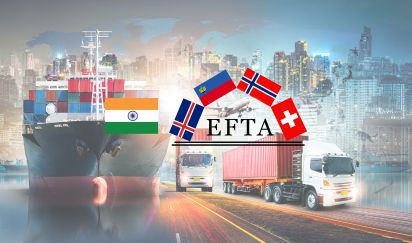
June 22, 2026 | Corporate & CommercialIndia’s growing network of Free Trade Agreements (FTAs) offers MSMEs valuable opportunities to expand exports and access global markets. However, improving awareness and effective utilization of these agreements remains key to unlocking their full potential.

As the world experienced the shock of Covid19, followed by the Ukraine-Russia war & US tariff shocks last year, it has become clear that we have moved from globalisation to protectionism in the 30 year journey of international trade. The gulf war this year has further enforced the necessity of supply lines & assured markets.
In these times, the government of India has been working with urgency to put together trade agreements that will assure market assess for Indian companies, especially MSME. The major challenge that MSME face with regard to Free trade agreements (FTAs) is lack of clear understanding & how to use these to their advantage.
1. The Utilization Problem: The "Preference Gap"
Trade data consistently reveals that "FTA utilization rates"—the proportion of eligible exports actually claiming preferential tariff treatment—remain stagnant, typically ranging between 20% and 30%. When Indian exporters default to Most Favoured Nation (MFN) rates despite an active FTA, they effectively pay higher tariffs than their global competitors, eroding their price competitiveness in high-value markets. This "preference gap" is a significant structural lost opportunity.
2. The MSME Opportunity: Scale and Potential
With over 80 million registered enterprises, the sector contributes approximately 30% of GDP and over 45% of merchandise exports. From Ludhiana’s knitwear and Moradabad’s brassware to Tiruppur's garments and Pune's auto components, these clusters are already export-oriented. The challenge is ensuring they can leverage modern FTA frameworks.
Competitors such as Vietnam and Bangladesh have demonstrated that systemic, state-supported outreach can push utilization rates toward 40–50%.
The India-UAE Comprehensive Economic Partnership Agreement (CEPA), implemented in May 2022, served as the modern template for this new era, effectively bridging goods and services trade. India is no longer viewing trade agreements solely as instruments of market access, but as vital mechanisms for supply chain repositioning, investment attraction, and geopolitical alignment in the new world order.
As of mid-2026, the following table summarizes the key engagements currently in force or at advanced stages of implementation.
|
Agreement |
Partner(s) |
Status |
Key MSME-Relevant Sectors |
|
India-UAE CEPA |
United Arab Emirates |
In Force (2022) |
Jewellery, textiles, pharma, IT services |
|
India-Australia ECTA |
Australia |
In Force (2022) |
Critical minerals, textiles, pharma, IT |
|
India-ASEAN FTA |
10 ASEAN Nations |
In Force (2010) |
Chemicals, auto components, electronics |
|
India-Japan CEPA |
Japan |
In Force (2011) |
Engineering goods, auto parts, steel |
|
India-South Korea CEPA |
South Korea |
In Force (2010) |
Chemicals, machinery, electronics |
|
India-Singapore CECA |
Singapore |
In Force (2005) |
Financial services, fintech, IT, logistics |
|
India-Mauritius CECPA |
Mauritius |
In Force (2021) |
Financial services, ICT, textiles, seafood |
|
India-Sri Lanka FTA |
Sri Lanka |
In Force (2000) |
Textiles, tea, rubber, manufacturing |
|
India-MERCOSUR PTA |
Brazil, Arg, Par, Uru |
In Force |
Agriculture, chemicals, auto parts |
|
India-EFTA TEPA |
Swiss, Norway, Ice, Liech |
In Force (2025) |
Pharma, green tech, financial services |
|
India-Oman CEPA |
Oman |
In Force (2026) |
Engineering goods, pharma, textiles |
|
India-UK CETA |
United Kingdom |
Signed (2025) |
Textiles, leather, auto, IT services |
|
India-EU FTA |
European Union |
Concluded (2026) |
Pharma, agri-processing, digital services |
|
India-New Zealand FTA |
New Zealand |
Signed (2026) |
Horticulture, wool, education, engineering |
|
India-GCC FTA |
Saudi, Qatar, Kuwait, etc |
Negotiation (2026) |
Energy, petrochemicals, logistics |
| If you would like to explore how your business can benefit from India's FTAs or other international trade agreements, COMPLETE THE FORM below to schedule a confidential, no-obligation discussion with our team. Alternatively, you may write to us at office@indialawoffices.com |
MSME in India need to master the art of utilizing these FTA to ramp their exports up, establish their presence overseas and learn how to comply with the conditions of these FTAs.
Simple approach; explore the latest FTAs listed below:
A slightly complex but highly gainful approach is to understand FTAs that other countries have signed with markets that are tough for India. If we pick up Vietnam as an example, if an Indian company sets up a structure in Vietnam, it can use the FTAs of Vietnam with China, ASEAN & RCEP countries ( including Japan, Australia, NZ, South Korea etc) and with just 40% local content, they can use Indian components to capture these markets.
Given the way world markets have moved, using FTA is not an option but a necessity for them. It is time for Indian MSME to claim their place in the new world that is emerging.
 Thank you for getting in touch!
 We appreciate you contacting us at India Law Offices. We will review the details that you have submitted and one of our experts will connect with you shortly.
Here are some of the other related articles authored by our experts which might be of interest to you.