October 13, 2026 | Corporate & CommercialIndia’s nine trade agreements open new opportunities for businesses to access global markets, reduce export costs and strengthen international competitiveness. This joint guide by CII and India Law Offices LLP explains the key benefits of each agreement and provides practical guidance on claiming preferential tariffs, meeting rules of origin and expanding into new markets.
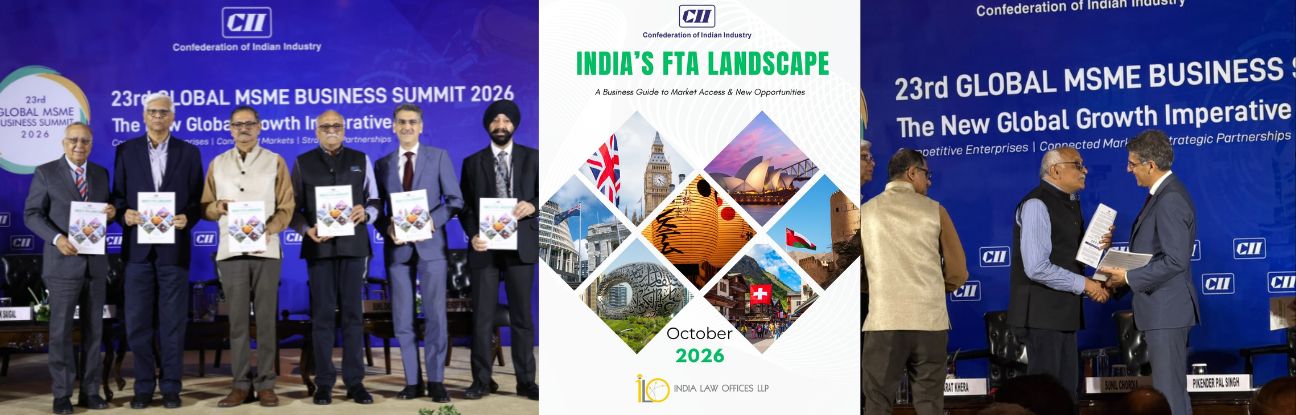

India’s trade agreements now open duty-free or reduced-duty access to some of the world’s largest markets. This new guide by CII and India Law Offices LLP explains where the opportunities are and how Indian businesses can use them.
Released at the 23rd CII Global MSME Business Summit 2026 on 13 October 2026, India’s FTA Landscape: A Business Guide to Market Access & New Opportunities is a joint publication of the Confederation of Indian Industry (CII) and India Law Offices LLP. It covers India’s agreements with:
the United Kingdom (UK)
New Zealand
Australia
Japan
Oman
the UAE
ASEAN
the European Union
EFTA (Switzerland, Iceland, Norway, & Liechtenstein)
The savings are already written into these agreements, but most Indian businesses are not collecting them. Indian exporters claim only 20–30% of the preferences available to them, while partner-country exporters selling into India claim 60–70% (GTRI, June 2026). The guide is written to close that gap, with agreement-by-agreement analysis, worked examples and step-by-step claim routes.
United Kingdom (in force since 15 July 2026): 99% of India’s export lines enter duty-free, with a projected £25.5 bn a year in added bilateral trade. Processed food and apparel stand to gain, and 137 UK services sub-sectors are open to Indian suppliers.
New Zealand (from 20 October 2026): all 8,284 tariff lines become duty-free for Indian goods from day one, and duties of up to 10% on apparel, footwear and engineering goods fall to nil.
EFTA (in force since 1 October 2025): 99% of export lines enter duty-free, alongside USD 100 bn of committed investment into India over 15 years.
European Union (pending ratification): the largest agreement India has signed, covering over €120 bn in trade, with the steepest cuts on leather, apparel and marine products.
Australia, Oman, UAE, Japan and ASEAN: Australia and Oman offer near-total duty-free access, the UAE is the largest buyer of Indian jewellery and electronics, and the older Japan and ASEAN agreements are under review.
Winning the benefit depends less on the duty rate than on getting the details right. Goods are often classified under the wrong tariff code, origin requirements are checked only after a claim is questioned, and certificates are obtained after the goods have shipped. Standards, registrations and biosecurity or carbon-levy checks can also stop a shipment even when the preference applies.
The guide covers each of these, for example:
Rules of origin: how to prove your goods count as Indian-made under each agreement.
Worked examples: real kinds of exporters, such as cotton knitwear and auto components, followed from “does it qualify?” to a claimed preference.
Beyond tariffs: New Zealand biosecurity, EU and UK carbon levies, and labour mobility under the Oman and Japan agreements.
Claim routes: separate step-by-step tracks for exporting and for importing, with the portals and helpdesks named.
A preference is most valuable in the early years, before competitors adjust. Buyers often re-tender supply when an agreement takes effect, which is an opportunity for a small supplier that already has its documents in place. The guide also includes a sector guide matching ten export sectors to the strongest agreements, a ten-point checklist for any agreement, and a calendar of upcoming changes, so businesses can plan ahead.
For firms that have never exported or imported, the guide sets out the registrations to complete before the first shipment, and how to move from setting up the business to claiming an agreement’s benefits.
If you would like a copy of the guide, or want our team to assess which agreements suit your products and markets, please reach out to us.
 Thank you for getting in touch!
 We appreciate you contacting us at India Law Offices. We will review the details that you have submitted and one of our experts will connect with you shortly.
Here are some of the other related articles authored by our experts which might be of interest to you.